Don’t Hire Skinny People!
This was the advice given to me by a (no doubt) well-meaning person in one of the markets in which try worked.
A little more research on this word of advice informed me that what they really meant was that “skinny” staff were fine, but they were more prone to falling sick or to exhaustion after stressful events in their lives. This person’s belief was that they lacked the necessary physical stamina to cope which then somehow translated into mental stamina.
Happily, experience shows that it’s not just “skinny” staff who are prone to this. It can happen to anyone of us. Body shape, height or size don’t matter. In fact, if the person is “skinny” because they run marathons, etc, then they’re likely to be far fitter and have more stamina than most of their colleagues (as well as eating more healthily, perhaps)!
It got me thinking though, what other inherent or secret biases may people have? How much can this impact interviews? What about the "wrong school", "overqualified", "lives too far away", and other such "excuses"?
We’re all prone (unfortunately) to inherent and unconscious biases due to the way we were brought up, our family, our education, our culture, the country we live in and so on. Being conscious of these is one thing, ensuring they don’t get in the way of hiring effective people is totally another.
I deliver change in markets ranging from the most developed to “emerging” economies. With a wealth of international experience in international financial services around the world running different operations and lending businesses, I started my own Consultancy to provide solutions for improving performance, productivity and risk management. I work with individuals, small businesses, charities, quoted companies and academic institutions across the world. An international speaker, trainer, author and fund-raiser, I can be contacted by email.
Labels: Career, Leadership, Social
Star Wars
Earlier this year, I attended a 50th anniversary screening of “Star Wars: A New Hope” in Kuala Lumpur. The original was actually released in May 1977 (which technically made this the 49th anniversary but never mind) and I remember going to see it as a 15-year-old with my younger brother at a cinema that no longer exists.
Some may accuse me of being a “nerd” (or worse!) but what was fascinating was how many people of all ages and cultures had gathered for this event. Most, to be fair, were at least in their 20s or 30s and wouldn’t have seen the original, digitally un-enhanced version “back in the day”. What united us all was a love of this incredible “space opera”: the characters we all know and love and some of the most famous lines in sci-fi history (“I’ve got a bad feeling about this…”, “I find your lack of faith disturbing,” “That’s no moon, it’s a space station!”).
Some of the audience were in Star Wars costume (I wasn’t, although I did wear a shirt with small prints of one of the spaceships from the franchise).
The film was accompanied by live music by the Malaysia Philharmonic and from the first bars (the “20th Century Fox Fanfare”) to the final credits, all the music we knew and loved from the first film was instantly recognisable and performed flawlessly. At times one couldn’t hear the dialogue as it was drowned out by the orchestra but most of us knew those scenes well enough not to have to worry (and in any case, Malay subtitles were played underneath for those who needed to follow along!).
As we left, I looked around the audience. There were smiles, laughter, shared memories strangers chatting with strangers and general happiness on the faces of people who’d relived memories of their past and had been allowed to forget for a moment what was going on in the current galaxy…
What united us across age groups, nationalities, religions and cultures? Quite simply, an overriding bond of love of “Star Wars”; something that transcended all these boundaries and reminded us all, in the end, of our underlying humanity, sense of fun, childhood (in my case) but also our ability to get together no matter what our differences might be.
I deliver change in markets ranging from the most developed to “emerging” economies. With a wealth of international experience in international financial services around the world running different operations and lending businesses, I started my own Consultancy to provide solutions for improving performance, productivity and risk management. I work with individuals, small businesses, charities, quoted companies and academic institutions across the world. An international speaker, trainer, author and fund-raiser, I can be contacted by email.
Labels: Leisure, Social
Missing the Menu
A friend sent me a funny video of an elderly person who went to his local pub for a pint and a pie and, instead of ordering at the bar as he was accustomed to do, was told to “scan the QR code”.
The story’s narrated as a song and proceeds to detail the problems that this gentleman had: an old Nokia “dumb phone” and no ability to log on via QR code. In the end he gives up in disgust and goes home for dinner instead.
Why he chose to go and eat at his local pub instead of with his wife is neither here nor there, but what it does highlight is the trend amongst restaurants to ask patrons to scan a QR code rather than providing a menu. I realise that this may well be okay for the younger “tech savvy’ generations but some of us (me included!) still prefer a “traditional” menu as it’s easier to read than it is on a “smartphone”.
The “traditional” menu allows us to scan multiple dishes at a time and pick the combination that suits best. The downside with many menus viewed on a smart phone is that one may see only one or, at most, two choices at a time.
Result: it takes longer to order and there’s a risk that people may make a mistake or duplicate a dish due to clumsy fingers or other factors.
Some say that the QR process makes things “more efficient”. My question is: “For whom?” For those of us who pay to go out to eat, efficiency is about serving staff who know the menu, can provide advice, repeat one’s order back and can be summoned if things are slow to come or there’s something wrong with the meal. Generally, restaurant staff are still available, but part of the dining experience is interacting with others and this is now being taken away in the interests of “efficiency”.
One has two choices: either accept the inevitability of “technological progress” in what has been until now a social interaction or to patronise only restaurants that offer a “physical” menu, provide working experience to young people whilst teaching them customer service and other life skills.
Another option for restaurants might be to have boards on which favourite or best-selling dishes are displayed for those who don’t want to use technology. Not only would it retain business, but it would also help shift popular dishes or even “low-moving” ones if the restaurant so wished!
Question: is going out to eat a social experience for diners and restaurant staff or is it becoming a “commodity” where diners go in, eat, and leave in the shortest possible time?
Are we, in our efforts to make our businesses or staff more “efficient”, driving our best customers away?
I deliver change in markets ranging from the most developed to “emerging” economies. With a wealth of international experience in international financial services around the world running different operations and lending businesses, I started my own Consultancy to provide solutions for improving performance, productivity and risk management. I work with individuals, small businesses, charities, quoted companies and academic institutions across the world. An international speaker, trainer, author and fund-raiser, I can be contacted by email.
Labels: Customer Care, Productivity, Selling, Social
"I Don’t Do Clocks…"
A contact who invigilates exams for school-age children told me that, during an exam, a student who needed to know how much time was left said “I don’t do clocks,” when the clock on the wall of the exam hall was pointed out to them.
The “boomers” are coming up to retirement or have already retired. I’m guessing that the student in question was doing at least their GCSEs and would therefore have been from the end of the “Gen. Z” era or perhaps even “Alpha” generation.
What fascinated me was that this student is clearly of “that generation” that grew up with more exposure to digital timekeeping and, possibly, don’t wear a watch as their smart phone has a clock! This tells us more about how we ‘re developing as humans rather than that the younger generation are somehow “deficient” because they can’t read a 12-hour clock.
Is this a typically “first world problem”? How many students of the same age in what are called the “developing” countries of the world are lucky enough to have a smart device in their home, let alone own an analogue (12-hour) watch?
I see plenty of jokes about how to confuse this age’s children by putting them in a room with a rotary dial phone and provide instructions how to use it in cursive writing. Yes, there’s a degree of fun or irony in such humour, but it nonetheless illustrates that society has moved on. How many of my generation would know what a “mangle” is (for those interested, it’s a device that was used to squeeze water out of clothes that had just been washed before the invention of the tumble dryer)?
Equally who knows what a “dumb waiter” is? The answer: a miniature lift that communicated between the basement kitchen and the dining room of wealthier houses “back in the day”.
Society will continue to develop with time. If it didn’t, we’d still probably be living in caves and wearing animal skins.
Yes, it’s sad to see that young people these days may not know how to use a 12-hour watch or clock, but I bet they could ring run rings round many of us on social media and ChatGPT usage!
Conclusion: understand (even if you don’t like it) that they’re different and that they have skills that “our generation” will never fully master.
Much has been said, written and discussed about the “generation gaps” present in our society. We have the “Silent Generation” (those who survived WWII), the “Baby Boomers” (those born between 1946 - 1964). After them came “Gen. X” (1965 - 1979), “Gen. Y” (1980 - 1994), “Gen. Z” (1995 - 2009), “Alpha” (2010 - 2024) and last, but not least, “Beta” (2025 - 2039). Each has its own characteristics which were the subject of two articles in February and March 2024.
I deliver change in markets ranging from the most developed to “emerging” economies. With a wealth of international experience in international financial services around the world running different operations and lending businesses, I started my own Consultancy to provide solutions for improving performance, productivity and risk management. I work with individuals, small businesses, charities, quoted companies and academic institutions across the world. An international speaker, trainer, author and fund-raiser, I can be contacted by email.
Labels: Customer Care, Productivity, Social
My Word is my Bond
In the “Old Days”, deals were sealed with a handshake. If you didn’t do what you said you would do when you said you would do it and at the price you had agreed, you quickly earned a reputation of an unreliable business partner.
Fast forward to the modern era of contracts where now no business deal can be sealed without a contract equal in thickness to the Encyclopaedia Britannica or some other weighty volume. Although these days we have the advantage of “soft copies” on computers, they must nevertheless be validated and may often still be printed out.
Contracts aside, as business owners and leaders, we undertake to do certain things for others: our staff, our business partners, our friends and family. Although these aren’t “written agreements”, and certainly can’t be enforced in a court of law, when we say that we’ll do something for someone, we’re undertaking something and building an expectation that we can be relied upon to do it.
Too often, however, the excuses start here: “It was a bad day for me!”, “I was busy.” (a favourite against which there is no real argument in theory), “We had an emergency.” (yes, these happen, but did we contact the other person to say it had happened and that we’d be delayed?) or “X, Y or Z got in the way).
In the case of verbal undertakings, our word is still our bond and people judge us on whether we keep our promises or not. There are certain individuals whom I have classified as “unreliable” and “easily distracted”. In fact, in the latter case, I know that I can manipulate them simply by creating a “distraction” if I want them to forget that I’ve undertaken something for them!
Not to deliver on one’s undertakings is, in some people’s opinion, an egregious illustration of “moral bankruptcy”. Everyone understands that emergencies can and do arise, or that something may distract us, but we still need to remember that we’ve undertaken to do something for someone by a certain time and that, if we find ourselves unable to do it because of unforeseen and uncontrollable external circumstances that have suddenly risen, the least we can do is contact the other person to explain the situation and that we’ll get back on it.
If we find that people start to avoid us, not deal with us or not be prepared to provide references for us, this could be the reason. For some, “once is enough”; others may be more patient but still after one or two more instances of failure to deliver, they’ll label that person as “unreliable”.
With all the alternatives out there, keeping our “word” is more important than ever.
I deliver change in markets ranging from the most developed to “emerging” economies. With a wealth of international experience in international financial services around the world running different operations and lending businesses, I started my own Consultancy to provide solutions for improving performance, productivity and risk management. I work with individuals, small businesses, charities, quoted companies and academic institutions across the world. An international speaker, trainer, author and fund-raiser, I can be contacted by email.
Labels: Leadership, Productivity, Social
Can "Feedback" be "Bullying"?
I was talking with a diplomat who told me a story about a colleague who had been accused of “bullying” when they provided performance feedback to a junior member of staff.
It made me think: where does the line between constructive feedback and “bullying” actually lie? One of our roles (if not duties) as leaders is to get people to be the best they can to further their careers. If we spot something that may hold them back, we have not only a professional but (some would say) a moral obligation to inform them.
The problem, as I see it, is that certain people don’t like anything that could be construed as “negative” or “hurtful”. Yes, some feedback will, inevitably, fall into one or both categories (the truth sometimes hurts).
The distinction I draw is that bullying can be defined as “offensive, intimidating, malicious or insulting behaviour involving the misuse of power that can make a person feel vulnerable, upset, humiliated, undermined or threatened" (ACAS).
The Australian Human Rights Commission defines bullying as “… when people repeatedly and intentionally use words or actions against someone or a group of people to cause distress and risk to their wellbeing. These actions are usually done by people who have more influence or power over someone else, or who want to make someone else feel less powerful or helpless. They cite the following examples:
- Keeping someone out of a group (online or offline)
- Acting in an unpleasant way near or towards someone
- Giving nasty looks, making rude gestures, calling names, being rude and impolite, and constantly negative teasing.
- Spreading rumours or lies, or misrepresenting someone (i.e. using their Facebook account to post messages as if it were them)
- “Mucking about” that goes too far
- Harassing someone based on their race, sex, religion, gender or a disability
- Intentionally and repeatedly hurting someone physically
- Intentionally stalking someone
- Taking advantage of any power over someone else like a Prefect or a Student Representative.
In general, bullying must contain three elements. It must be:
- Repeated
- Intentional
- Involve a power imbalance
An even simpler definition might be behaviour with “intent to cause harm”, a “single egregious act” or repeated “hostile” behaviour.
We must balance two risks: the risk that a person may get away with “real” bullying of another against the risk that, to avoid an unpleasant conversation, someone may claim they’re being bullied rather than look to improve their performance.
This is likely to mean that businesses and organisations will need to develop internal definitions of “bullying” (and have them reviewed by a legal expert) to ensure that, whilst staff are protected as much as possible, they can be given valid, constructive feedback to improve their performance.
I deliver change in markets ranging from the most developed to “emerging” economies. With a wealth of international experience in international financial services around the world running different operations and lending businesses, I started my own Consultancy to provide solutions for improving performance, productivity and risk management. I work with individuals, small businesses, charities, quoted companies and academic institutions across the world. An international speaker, trainer, author and fund-raiser, I can be contacted by email.
Labels: Career, Leadership, Social, Teamwork
Is "Ageism" Real?
“Ageism” can be defined as “bias or prejudice against people over a certain age who are treated unfairly as a result”.
The problem is that individual views on what constitutes and “older” person differ. Nowadays, people live longer, generally retain their physical and mental health longer and can be productive workers for longer than in the past thanks to advances in technology and medical science.
We’ve seen examples of ageism: “humorous” birthday cards mocking older people which impact others’ views come to mind in particular. The disparaging “OK Boomer!” response to anyone older giving advice is also common. This results in a number of consequences including job prospects for all the people
Examples people have experience include:
- Being patronised.
- Losing or not being hired for a job because of your age.
- Being refused credit, car insurance, travel insurance.
- Low quality of service in shops or restaurants.
- Being refused membership to clubs or associations because of age.
Some employers won’t hire people over a certain age on the grounds that they’re “too old” and may require more time off, more healthcare, more pay, may be slower and a variety of other reasons. In some cases, this may be true, but perhaps no truer than for younger counterparts with the new diagnosed medical conditions that require special consideration or allowances. These seem to have impacted less on their ability to find work.
The proliferating number of “conditions” requiring special care or conditions of work is increasing. The case for discriminating against older people however they’re defined, is at best, weak.
Let’s consider some of the advantages of hiring an “older” worker:
- They have life experience that their younger counterparts lack, enabling them to solve problems younger ones can’t.
- They have “human skills” that again many of their younger counterparts lack.
- They’re likely to be more patient when confronted with adverse situations.
In short, discriminating against older people because of their age is just as unacceptable as discriminating against people based on gender, race, religion, orientation, political views etc.
Wouldn’t it be ironic if “reverse ageism”, where people discriminated against younger people again because of their age, suddenly made an appearance?
As business leaders, it’s our job to ensure we hire only the best, no matter their age. "Inclusivity" starts with us!
I’ve spent more than half my life delivering change in different world markets from the most developed to “emerging” economies. With a wealth of international experience in international financial services around the world running different operations and lending businesses, I started my own Consultancy to provide solutions for improving performance, productivity and risk management. I work with individuals, small businesses, charities, quoted companies and academic institutions across the world. An international speaker, trainer, author and fund-raiser, I can be contacted by email.
Labels: Career, Leadership, Productivity, Social, Strategy, Teamwork
Telephone Queues
A posting appeared in LinkedIn about the newly installed ATM on the island of Tuvalu. Whilst the author could imagine delighted bank customers no longer having to queue for cash at the bank’s counters, she highlighted one of the problems of technology’s impact on our society.
Her concern revolved around “customer service” and how, in an effort to save costs, companies are turning more and more to technology and Artificial Intelligence (AI) to provide for customer needs. I’ve been using ATMs for longer than I can remember; supermarkets now have self-service checkouts (which often seem to have a problem one way or the other, requiring a supervisor to still be in attendance) and other organisations are now "training up" AI to answer customer telephone queries.
The point? Face-to-face, human interaction is becoming less frequent. For some, their weekly trip to the supermarket may be the only chance they have to talk to a “real person” when they pay for their goods at checkout.
More frustrating however, were the author’s experiences of calling a “customer helpline” only to be faced with a myriad of button press choices in order to locate the service they wanted and then either waiting “on hold“ for ages, being cut off or forced to go back to stage one to repeat a menu which didn’t seem to cater for their particular issue.
Despite the hype, human interaction is still critical and AI is not the solution to a business’ financial woes.
Despite the efforts of technology companies, humans still need human interaction and the intuitive leaps that only a human can make to solve their problems.
I’ve spent more than half my life delivering change in different world markets from the most developed to “emerging” economies. With a wealth of international experience in international financial services around the world running different operations and lending businesses, I started my own Consultancy to provide solutions for improving performance, productivity and risk management. I work with individuals, small businesses, charities, quoted companies and academic institutions across the world. An international speaker, trainer, author and fund-raiser, I can be contacted by email.
Labels: Customer Care, Productivity, Social
Harmful Devices?
I’m sitting in a clinic’s reception area waiting for an appointment. Behind me is a young child (obviously waiting with other) for an appointment whilst watching some kind of children’s programme on mother’s smartphone to keep them amused (and quiet?).
My question is, what’s this doing to the child’s development? Before smartphones and their ability to deliver on-the-spot gratification, what did we do? Answer: if we knew we were in for a long wait, we brought a book, books of puzzle games, drawing books, caught up with our journals or any other activity that engaged our minds.
These days, one sees very few instances of this. Instead, it’s mind-dulling activity potentially robbing us of future generations of artists, musicians, creators, authors and the like.
The trouble is, it’s too easy to hand them a smartphone to keep them quiet.
What if we engaged them in conversation, played games (that didn’t require running around) instead? If we’re “dumbing down” their minds at this stage, small wonder people complain of educational standards also being “dumbed down.
Now we’ve got “Artificial Intelligence” - what about dealing with “Natural Dumbness” first? Is Ai the natural response to instant gratification?
We’re continually told we need the “skills” to react to a “fast-changing world”, but developing these skills starts when we’re young with conditioning the mind.
More interaction, less “camer-action”?
I’ve spent more than half my life delivering change in different world markets from the most developed to “emerging” economies. With a wealth of international experience in international financial services around the world running different operations and lending businesses, I started my own Consultancy to provide solutions for improving performance, productivity and risk management. I work with individuals, small businesses, charities, quoted companies and academic institutions across the world. An international speaker, trainer, author and fund-raiser, I can be contacted by email.
Labels: Social
So, Where Are You From?
This is a question we get and hear regularly. Assuming we don’t interpret it as a politically incorrect, racist, anti DEI statement, how do we respond?
People might say they’re from… and the name of the city or country. Others, like me find it more difficult.
I was born in Asia as were my parents.
I was educated in Pakistan, the USA and the UK. I’ve worked in eight different countries in the world from the Far East to the Caribbean.
My mother lives in the South of England. One of my siblings lives west of London, the other in France.
I’ve now lived in Brunei for the past 12 years and am married to a Brunei citizen.
I carry a British passport…
So how do I answer? “Where are you from?”. I don’t consider this an invasive or offensive question. It makes me think. Where am I “from”? Am I “from” the part of the world in which I was born, educated, live now or whose passport I carry?
How do children of mixed marriages or “third culture kids” answer? How do I myself identify?
Boundaries are blurring. Mixed marriages are completely normal (although when I was a young child, they were still very much a novelty). Some societies turn in on themselves; others are outward looking and embrace the changes that this brings.
So back to “Where are you from?”. The short answer is “you tell me!”. I’ve loved living, being educated in, and working in every country whose shores I’ve touched. I’m British by nationality and loyal to the crown but also support where I live and work now.
I have multiple “identities”.
I love the diversity that we can now find in this world, where in the Far East I can encounter someone of Indian origin who speaks with the strongest Birmingham accent. Labelling people by “where are you from?” Is becoming an increasingly complex process.
Perhaps some of the social problems we face in the world are because people can’t identify “where they’re from”. They feel they have no identity or place in the societies in which they find themselves. These may be the children of immigrants to a country, refugees, or anyone who finds themselves in an environment radically different to that which their parents and grandparents may have known. The sense of displacement and “not being one of us” can have the most significant impact on the psyche of these people.
Similarly, some people clearly have difficulty in “identifying” others if they can’t put them in a “pidgeon hole”.
Why will I ask someone where they’re from? It’s because I find it fascinating to be in a third country and meet someone who is clearly not from that country either. What’s their story? What did they go through to get there? What does that make them as a person? What might they have experienced? Life can we the most fascinating tapestries and yet we still at times insist on using the same-coloured thread.
Why not change the thread?
I’ve spent more than half my life delivering change in different world markets from the most developed to “emerging” economies. With a wealth of international experience in international financial services around the world running different operations and lending businesses, I started my own Consultancy to provide solutions for improving performance, productivity and risk management. I work with individuals, small businesses, charities, quoted companies and academic institutions across the world. An international speaker, trainer, author and fund-raiser, I can be contacted by email.
Labels: Customer Care, Social
“Foreign Influence”
From time to time I read with great amusement comments by various statesman or other influential people about the need to “purge foreign influences“ or “not succumb to foreign influences“.
At times it may be understandable: people don’t want to lose their national identity. Some comments suggest more these people are living on a different planet. Let’s see: they wake up in the morning thanks to an alarm set on their “foreign” smart phone. If they are still of the type who wish to use an actual alarm clock, it will probably won’t be made in their country.
After getting up, they (one hopes) shower using shower products made in any number of other countries, after which they dry themselves on a towel again made (most likely) in China.
They then dress in clothes made overseas (in India, Bangladesh, China or if they can afford it, Parris, Milan, Savile Row).
They then have a cup of coffee for which they boil the water in their Chinese or Korean kettle. After that, they leave the house and, if they drive themselves to work, most do so in a car made in China, Japan, Korea, Germany, the UK, or the USA.
On arriving at work (at the local subsidiary of, say, an overseas bank) they go to their desk and switch on a computer made in China, Korea, the USA. Their desk and office chair may well have been manufactured in a different country as well.
For lunch, they may well decide with their colleagues to go out for foreign food. After leaving work and driving home in their foreign car, they change and relax in front of their Japanese, Korean or European TV.
Dinner may be a simple affair: a microwaved meal, cooked in their Korean microwave. Afterwards they load the dirty dishes and cutlery into a Korean or German dishwasher. Following a relaxing cold drink from the Korean made fridge, they head upstairs to bed before beginning the whole process the next day again.
The lust to “purge foreign influences” seems characteristic of national populists and those trying to carry favour with a minority of the population.
Unless we go and live in a remote cave, “foreign influences” can no more be purged from our lives than can our hearts or lungs. Like the latter, they are an integral part. Were we to genuinely “purge” them, we’d be left stark naked, with no (or very few) possessions and probably little gainful employment.
I’ve spent more than half my life delivering change in different world markets from the most developed to “emerging” economies. With a wealth of international experience in international financial services around the world running different operations and lending businesses, I started my own Consultancy to provide solutions for improving performance, productivity and risk management. I work with individuals, small businesses, charities, quoted companies and academic institutions across the world. An international speaker, trainer, author and fund-raiser, I can be contacted by email. My website provides a full picture of my portfolio of services
Labels: Leadership, Leisure, Social
How I Will No Longer Use Facebook
How many of us have “that friend” (or “those friends”) who post everything they do, remember, feel, eat or experience on Facebook?
I have a few. I love seeing what they’re getting up to if they have something newsworthy to say. I have difficulty in believing that my Facebook contacts care that I am “eating lunch” at (name of restaurant). Equally, I doubt they’re interested in the fact that I’m at (name the place) with no further information to go on. I also suspect they’re not particularly interested in what I’m having to eat/drink.
I once saw a meme stating “believe it or not you can do things without posting them for everyone to see on Facebook!” How true!
I follow three simple rules when posting on Facebook, namely that my posts should be:
- Interesting/informative OR
- Inspiring/thought-provoking OR
- Amusing
I wonder how “interesting” people find it that I am having a pint of beer (guilty as charged!). To put this in context, I live and work in a “dry” country, so for me being able to order a pint is a treat (and my contacts would understand that).
There’s enough “clutter” out there on Facebook, some of it best described as “completely moronic”, without us adding to it. As one wag once put it, “We used to have village idiots; now with the internet they’ve gone global!” I would rather not be numbered among the idiots…
So from now on, I shall regale my Facebook contacts with only interesting, informative, thought-provoking or amusing posts. It means that I won’t “share memories” as is the wont of many of my contacts. To me doing this seems nothing more than a desperate craving for attention (or should that be “like” emojis?).
Something else worth mentioning is that, when we meet somebody new or interview for jobs, people check us out on social media. I only use Facebook and LinkedIn but there are others who use these two along with Snapchat, Instagram, TikTok, X and whatever else is out there. Not only does this make for a minefield to manage, it also means that it’s too easy to post something “contentious” and forget that it’s there. With more and more use being made of social media postings to pillory others, this strikes me as a fairly sensible move.
Do you have your own personal rules as to what you post and where?
I’ve spent more than half my life delivering change in different world markets from the most developed to “emerging” economies. With a wealth of international experience in international financial services around the world running different operations and lending businesses, I started my own Consultancy to provide solutions for improving performance, productivity and risk management. I work with individuals, small businesses, charities, quoted companies and academic institutions across the world. An international speaker, trainer, author and fund-raiser, I can be contacted by email. My website provides a full picture of my portfolio of services.
Labels: Career, Leisure, Social
Experience Counts!
I recently read an article on LinkedIn written by a young owner of a company, describing how he had hired an “older person” and they had been a success.
Two things struck me here:
- His delight that things had worked out so well. Why should they not have? Older people generally have more maturity, experience and have seen more problems and their solutions.
- The fact that there may be a perception that only “young” workers can be successful.
Let’s go back to that word “maturity”. This consists of “experience” and having “seen it all before” (or a lot of it). Young people these days, however well-educated, often lack the “streets” to handle many problems. They’ve been indoctrinated with political correctness, virtue signalling and other concepts considered by left-leaning teachers as “important” in today’s society. What they haven’t been taught are skills such as how to deal with an angry customer, how to solve a problem with their colleagues, how to analyse a situation and find what caused it, how to have a “difficult conversation”.
Many of these skills require a certain mindset. When confronted by an angry customer, stating “I’m offended” may stop them in their tracks but it won’t solve the problem. Why do we need customer service training these days? Because too many new young recruits lack these skills and the emotional intelligence to handle angry people. They’re too used to walking away.
One of the key skills we should ask new recruits to demonstrate is that of critical thinking – the ability to look at things from different angles and not to just accept them if they conform with the echo chamber of their minds.
Older people will have developed these skills over time. They can be a calming and guiding influence on younger, less experienced workers.
They don’t always expect higher salaries because of their age.
They won’t always require more “sick leave”.
They’re not after the boss’ job.
They’re likely to learn faster and be productive in a shorter time.
With all the humour surrounding the “Boomer”, “Generation X”, “Millennial”, “Zoomer” and now “Alpha” generations, there’s clearly some understanding of how older workers differ. Why not use that to our advantage?
Being surprised that an “older worker” may actually do well is like being surprised that a driver with 10 years’ experience can drive better than one who passed their test the day before.
I’ve spent more than half my life delivering change in different world markets from the most developed to “emerging” economies. With a wealth of international experience in international financial services around the world running different operations and lending businesses, I started my own Consultancy to provide solutions for improving performance, productivity and risk management. I work with individuals, small businesses, charities, quoted companies and academic institutions across the world. An international speaker, trainer, author and fund-raiser, I can be contacted by email. My website provides a full picture of my portfolio of services.
Labels: Career, Leadership, Productivity, Social, Teamwork
The "Generation Game": Part I
As a child in the 80s, I remember watching The Generation Game hosted by Bruce Forsyth. The show involved teams of contestants - a parent and child usually - competing for prizes.
Nowadays, we play a different “Generation Game” as leaders. For reference, the generations that have been defined are:
Baby Boomers: | 1946-64 |
Gen X: | 1965-80 |
Millennials | 1981-96/ Early 2000s |
Gen Z (“Zoomers”): | 1997-2012 |
Gen A: | 2010-25 |
All of these generations have different needs and characteristics and being able to navigate between the “layers” is critical for leaders of whatever generation. Interestingly, a lot of the research I see assumes we’re managing downwards – i.e.: a Boomer managing Gen X, Millennials, etc. There seems to be a view that a Millennial won’t have to manage “in reverse”.
Briefly, the generations can be characterised like this:
Before the Boomers came the "Silent Generation" (1928-1945). This generation became adults between 1946 and 1963 and grew up with the aftermath of the Great Depression and World War II.
They fought in the Korean War and went through the witch hunts of McCarthyism in their early years. During their time, the U.S. became the world superpower and society changed rapidly as a result. Living standards rose, consumerism became dominant and suburbs began expanding. As many will have now retired, I include them for reference only. They form almost 13% f the global population.
Baby Boomers:
Born in the aftermath of World War II and grew up with the “Cold War”. Theirs was an era of economic prosperity and growth, developments in education, rebels, “hippies”, the “Nuclear Family”. They’re likely to believe in a strong “Work Ethic”, loyalty to their employer and the team and prioritise achievement. They believe in “the hierarchy”.
Older Boomers have started retiring, but those born towards the end of this generation have 5-10 years to go.
Gen X:
These were the “Latchkey kids” of the UK, the “MTV Generation” (remember the Dire Straits song?). High divorce rates were common due to severed parental relationships arising from little parental supervision as both parents worked (hence the term “latchkey kids”). Towards the end of their era and into the next, PCs began to make their appearance in homes and schools. This was the generation of entrepreneurs (the founders of Google, Wikipedia, Amazon were born during this era). Gen-Xers are self-reliant and tend to focus on goals.
Xers born at the beginning of their era still have 10-15 years to go, but others will be in mid-their career or may have founded their own businesses and have plenty yet to give.
Millennials:
Interestingly, we see a lot of jokes about this generation, particularly the Boomer/Millennial relationship. This generation were the first “Digital natives” with elevated usage of/familiarity with the internet, mobile devices and social media. Also known as “Generation Me” (need for constant feedback and reassurance), they’ve experienced slower economic growth, higher student debt and childcare costs.
Millennials born at the start of their generation will be mid-career. Those born toward the end of the Millennial era will just be starting out after graduating. They want to move on fast and “don’t do hierarchy” (let alone office rules) well. They fhave been responsible for significant advances due to their entrepreneurial spirit.
Gen Z:
Currently the largest generation on earth. These are the “neo digital natives” of our world. They’re more educated, well-behaved (they think) and a more stressed and depressed generation vs previous generations according to The Economistmagazine. They align with justice at the expense of personal gain. Gen Zers or “Zoomers” tend to voice their opinions and to lead from the front. They need and value purpose and therefore work aligned with their values. Simon Sinek describes them as lacking in “Human Skills”.
Zoomers born at the start of the zoom age have perhaps had a few years’ experience, at least two of which will have been during lockdown. They will have experienced “Remote Working” in full, may have been “let go” as employers cut costs during this time and may even have started their own businesses more aligned with their values. Those born towards the end are still in their teens with all the “baggage” inherited from two years/more of COVID. The latter will be entering the workforce in another 10 years. They may be the ones serving in cafés and restaurants.
Gen A:
The first generation born totally in the new millennium. They’re growing up n a world of falling fertility rates, mental health crises and experienced the full effects of COVID-19 in their pre- and teen years. This generation is dominated by technology, social networks and streaming services. As they’re never disconnected, “Screen time” means they learn fast, outside traditional methods of instruction.
Gen As are still in school and have another 10 years at least (assuming they go to university) before entering the workforce.
In short, we currently have a workforce consisting mainly of Boomers, Gen Xers, Millennials and some Zoomers. Each requires a different approach, which will be the subject of the next post.
I’ve spent more than half my life delivering change in different world markets from the most developed to “emerging” economies. With a wealth of international experience in international financial services around the world running different operations and lending businesses, I started my own Consultancy to provide solutions for improving performance, productivity and risk management. I work with individuals, small businesses, charities, quoted companies and academic institutions across the world. An international speaker, trainer, author and fund-raiser, I can be contacted by email. My website provides a full picture of my portfolio of services.
Labels: Leadership, Social, Teamwork
We Prefer Humans
A graphic appeared in my inbox from the Qualtrics XM Institute, which monitors customer experience and how to manage it.
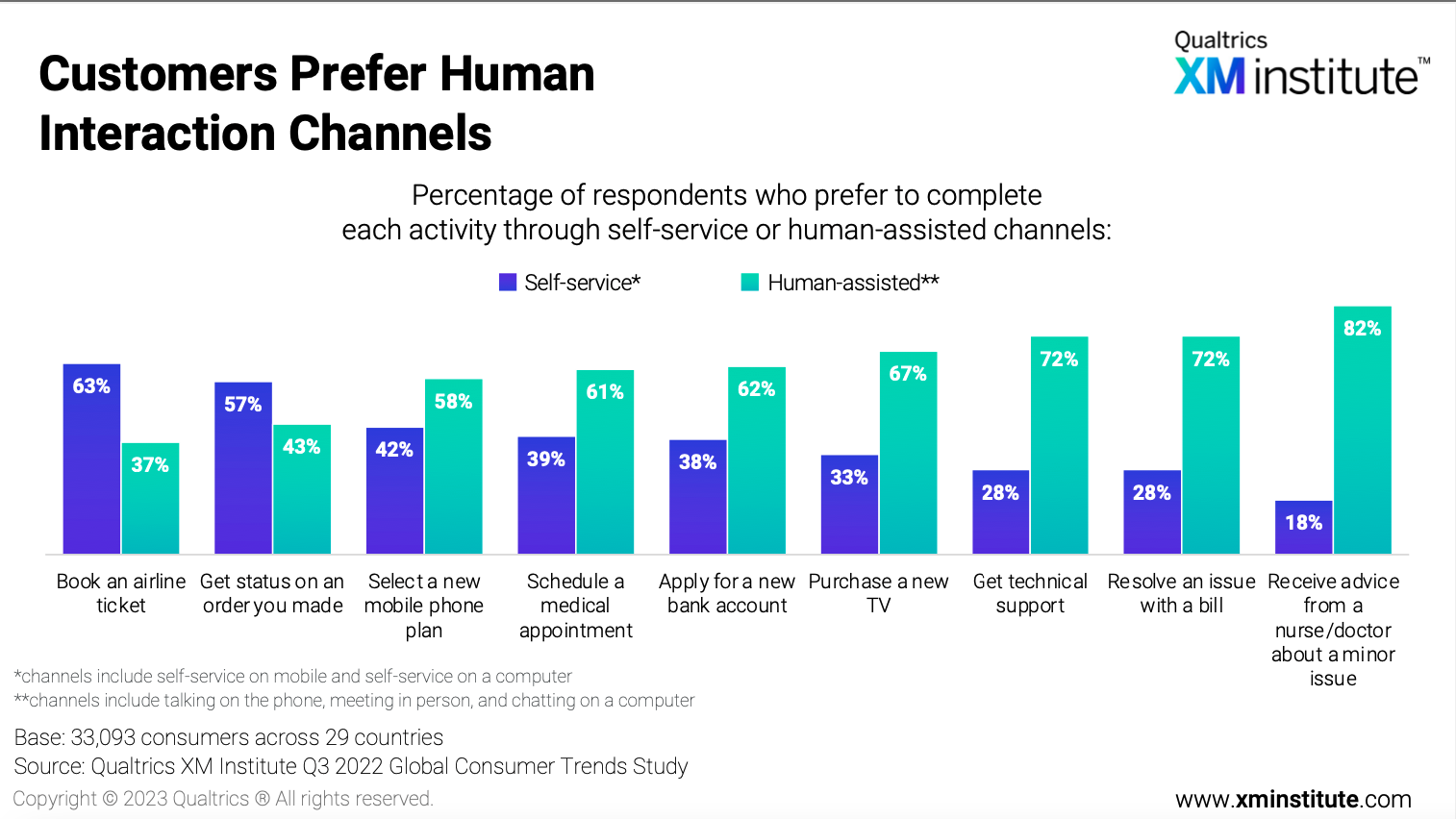
The key finding for me was that, in 80% of cases across nine typical interactions with product/service providers, customers preferred dealing with another human being and in several cases, up to 5 times more. In only two cases (booking airline tickets and getting a status update on an order placed) were they happy to use a remote service.
Humans are social animals. We enjoy interacting with others. One of the main contributors to the onset of dementia is social isolation.
Now look at many of the services we use. Most banks have some kind of online banking system towards which customers are directed. The same applies to many other service and product providers who tout their online systems as the solution to everything. Many times, it isn’t.
An amusing anecdote recounted to me by one of my mother‘s friends concerned her calling her bank branch and being told repeatedly that “the system” could answer any question. She rang 10 minutes later to explain that “the system” could not confirm to her, whether she had left her glasses at her branch when she visited earlier that day!
While all these remote channels are being introduced, customer experience seems to be on a downward trend and some service providers are even complaining that they don’t see enough of their customers. No surprise here considering that those very same providers have driven them away. In the UK, banks are closing branches due to costs (which admittedly are high for “bricks and mortar” branches) and also because they perceive that remote delivery systems (i.e. online banking) are sufficient to deal with most needs.
This also ignores another market: that of the computer illiterate. I’ve already written about this particular market – a generation of (mostly) elderly people who don’t use computers and see little benefit to them in doing so. Businesses, banks and other service providers are ignoring a potential section of their consumers. Give it another 15 to 20 years, however, and I suspect most of these customers will have left this world.
How much does your business rely on face-to-face interaction? How effective do you find yourself if you are able to deal with people face-to-face or online? In our business, we found that channels, such as Zoom only went a certain distance in supporting us. Towards the end of the COVID pandemic, everyone was heartily fed up with Zoom and remote working: ourselves, our clients and the institutions with whom we deal. Our first open “Live fair” saw a veritable tsunami of people coming to the venue we had booked.
We can never discount the face-to-face factor that forms such a critical part of our business. Those who do are likely to fall by the wayside.
I’ve spent more than half my life delivering change in different world markets from the most developed to “emerging” economies. With a wealth of international experience in international financial services around the world running different operations and lending businesses, I started my own Consultancy to provide solutions for improving performance, productivity and risk management. I work with individuals, small businesses, charities, quoted companies and academic institutions across the world. An international speaker, trainer, author and fund-raiser, I can be contacted by email. My website provides a full picture of my portfolio of services.
Labels: Customer Care, Leadership, Productivity, Selling, Social, Strategy


